


New field guide helps improve spreading accuracy for blended fertilisers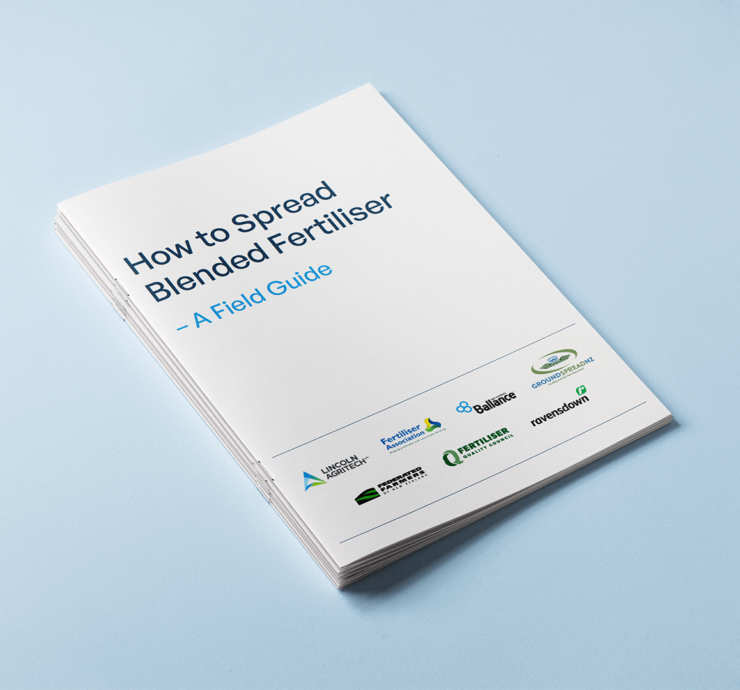
How to Spread Blended Fertiliser – A Field Guide is available to download free of charge here.
A new field guide developed from Ministry for Primary Industries-funded research will help farmers and contractors improve the accuracy of blended fertiliser spreading, with trials showing relatively simple changes can significantly improve application uniformity.
How to Spread Blended Fertiliser – A Field Guide has been developed through the Sustainable Food and Fibre Futures-funded project Reducing Off-Target Fertiliser Application and translates research findings into practical advice for day-to-day spreading operations.
The guide supports the globally recognised 4R nutrient stewardship principles: applying the right product, at the right rate, in the right place and at the right time.
Ravensdown Innovation and Strategy Manager Mike Manning says accurate placement is fundamental to getting value from fertiliser investment.
“Optimal fertiliser decisions start with optimal fertiliser placement,” Manning says.
Lincoln Agritech Precision Agriculture Agronomist Allister Holmes, who led the research, says one of the clearest findings was that spreading performance should be tested using the actual fertiliser product being applied.
“The headline message is to test your spreading with the actual fertiliser product you intend to apply and set your working width around the hardest-to-spread component in the blend,” says Holmes.
“None of the spreaders we tested met the Spreadmark uniformity standard at their typical 24 to 28 metre working widths when spreading blends of diammonium phosphate, sulphate of ammonia and potassium chloride.
“However, when we reduced the pass-to-pass distance to around 14 metres using a flat spread pattern, every spreader met the Spreadmark standard.”
The trials also found:
• None of the spreaders tested achieved acceptable uniformity when spreading blended fertiliser at typical working widths of 24 to 28 metres, while reducing the pass-to-pass distance to around 14 metres brought every spreader within Spreadmark standards.
• Spread testing should be carried out using the actual product being applied, as acceptable uniformity cannot be guaranteed without testing.
• Boundary control reduced fertiliser landing beyond paddock edges by an average of 69 per cent, although researchers found the first five metres inside the boundary received only around 63 per cent of the target application rate.
• Thirty-two metre tramlines resulted in unacceptably uneven spreading in the trials, while 18 metre widths using a conventional twin-disc spreader remained within Spreadmark guidelines.
• Only physically and chemically compatible products should be blended, and spreading widths should be set according to the component that is most difficult to spread accurately. Applying products separately remains the best way to achieve uniform spreading.
Ballance Regional Distribution Manager Upper South Island Jeremy Begg says the findings reinforce the value of getting spreading right.
“Good fertiliser spreading is an investment; poor fertiliser spreading is a cost,” Begg says.
Holmes says the guide has been developed for everyone involved in the fertiliser supply chain.
“Importers, manufacturers, wholesalers, spreaders, farmers, agronomists, consultants and regulators all depend on each other getting it right.
“Uniform spreading is not just about protecting waterways. It’s about making sure the money spent on fertiliser actually delivers the productivity benefits it is intended to.”
The project was delivered in partnership with the Fertiliser Quality Council, Groundspread NZ, Federated Farmers and Environment Canterbury. Spread testing was conducted by Spread Test NZ, with trial design and statistical analysis undertaken by VSN NZ.